MACBOOK PRO LED XDR is the name Apple gave the new display. It is less mysterious than it sounds: two stacked OLED layers, each pixel emitting its own light with no backlight. It can go truly black and genuinely bright. Apple quotes 1000 nits sustained full-screen, 2000 nits HDR peak and a 10,000,000:1 contrast ratio. For colourists that matters more than benchmark scores: no more guessing how far the laptop screen drifts while staring at a reference monitor. The gamut expands from P3 to P3 + Adobe RGB, which tells print and photography people what they need to know. The screen comes in 14.2-inch and 16.3-inch versions at 254 ppi, with optional nano-texture glass for another ¥1,125; outdoor SDR brightness reaches 2000 nits, so editing by a window is no longer like looking in a mirror.
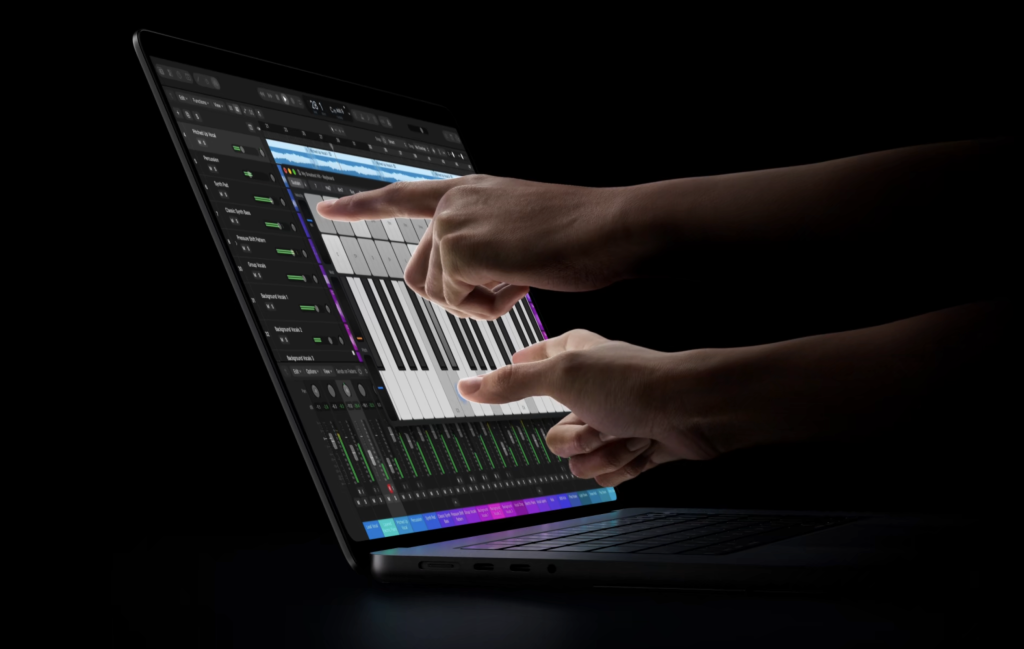
Touch is the other story. For the first time a Mac lets you scroll, zoom and draw directly with a finger. Apple stresses that the touch sensor is embedded in the display panel rather than layered on top, so latency is lower and it feels like touching the content itself. Both things are true: it does not replace the trackpad, because a pointer’s precision and keyboard shortcuts are things fingers cannot provide. But some work genuinely flows better, such as rotating 3D models, pushing faders in Logic, tapping the screen during client demos, or testing iOS touch input in Xcode. Those cases hold up.
Dynamic Island also comes to the Mac, handling Spotlight, Live Activities and notifications. On iPhone it exists to hide the camera cutout; the Mac has no such problem, so here it works more like a permanent status bar. Whether it is pleasant needs real-world use, but it beats a stack of banners in the top-right corner.
Performance is unsurprising: M5 Pro and M5 Max, up to 18-core CPU, 40-core GPU, 128GB of memory and 16TB of storage. The 14-inch M5 Pro weighs 1.38 kg, more than 0.2 kg lighter than the previous generation; the 16-inch is 1.82 kg. Three Thunderbolt 5 ports, HDMI, SDXC, MagSafe 3 and a headphone jack are all present, with Wi-Fi 7 and Bluetooth 6 filled in. The six-speaker system gains 50% more bass extension, and the three-mic array supports Voice Isolation. Apple rates battery life at up to 24 hours, with a 50% charge in 30 minutes.
Prices start at ¥22,999 for the 14-inch M5 Pro, ¥27,999 for the 16-inch M5 Pro, ¥36,999 for the 14-inch M5 Max and ¥38,999 for the 16-inch M5 Max. Pre-orders open at 9 a.m. on October 30, with sales on November 6.
Whether it is worth buying depends on who you are. For people who make a living from HDR grading, print proofing, 3D or medical imaging, this display and touch input are real productivity gains, and the price is justified. If you mostly write documents, browse and occasionally cut a vlog, a standard MacBook Pro without touch is the better deal; the extra brightness and touch would mostly go unused. And “the Mac finally has touch” is not a reason to upgrade by itself: it adds an input method, not a new machine.